

Organizers of Everyday Items – Keychain Pokeballs
December 24, 2025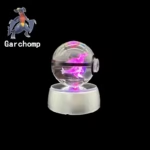
How to Present a Crystal Pokeball Without It Appearing Toy-Like
January 29, 2026
The collectible nature of a crystal Pokeball is surface-level in the sense that with the right lighting a crystal Pokeball can become a striking display piece. Great lighting can draw attention to not only the crystal’s engravings but to the conjugation of light within and the purity of the crystal.
How Light Enhances Engraved Crystal
The design of a Crystal Pokeball is internally reflective. When light comes in from the bottom or the side of the piece the engraved light refraction makes it appear to be illuminated from the inside. Lit focused lighting is even better than overhead lighting.
If a light source is positioned off center shadow is created. Off center shadow placement is a great way to define the internal details of the piece. Engraving can be overlooked with top down lighting even with a crystal’s gloss finish and shadow lighting can help engravings be illuminated with top down lighting.
Natural Light: Beautiful but Easy to Overdo
Natural light can make a crystal Pokeball sparkle. A window can provide a soft light to brighten a Pokeball but too much direct sun light will dull the clarity and damage elements over time.
Indirect light is better. A Pokeball should not be placed in direct light but rather an indirect light like a shelf perpendicular to a window.
A windowsill is an especially bad place to display a crystal. Though it looks like it should be good spot direct heat and light is a bad combination and will age a crystal fast.
LED Bases: Why They’re the Most Reliable Option
LED lights are a good choice for crystal displays because they are cool to the touch and energy efficient, White LED lights make engravings easier to see and color-changing lights provide a nice mood as long as the brightness is low.
Up-close highly bright LEDs create the danger of internal glare. Internal glare is when the engraving gets smoothed over making the engraving detail more difficult to be seen. This makes the Pokeball engraving look rather basic when that’s more likely the opposite of the case. Oftentimes a lower brightness setting will create a more rich and 3D effect on the engraving detail.
If a Pokeball is purchased without the display case and recess display bases are purchased the one with a shallower recess is the better choice. This is because that one better helps core the Pokeball with the recess and gets dust to the right angle for lighting.
The Dangers of Heat on Crystal Displays
The lighting on a display gets overlooked very often. The lighting gets overlooked because simple bulbs halogen lighting and even the closed display cases get to a warmth level that begins to melt the adhesives stands or internal imperfections over a longer period of time.
To better preserve crystal Pokeballs direct exposure to lamps heat venting and electronics should be avoided. If the hands get warm when touching the display the light is likely too bright.
The best choice for these situations are LEDs since they do not change temperature and they provide the best illumination.
Mistakes of Display Lighting
A simple solution to many of these lighting issues is simply adding more lighting. The simple addition of lighting often removes the whitewashing effect of the engraving and helps encourage a more even light distribution that can better help reduce reflections.
Another common error is putting the Pokeball directly onto reflective surfaces like glass shelves without a base. This results in light reflecting in different directions which can make the engraving more difficult to see.
Conclusion
Lighting is not simply an accessory for crystal Pokeballs—it is what turns them from simple collectibles into more spectacular pieces. The crystal’s visual impact is enhanced while its protective attributes are utilized with strategic positioning dim LED lighting and limited use of natural light.
